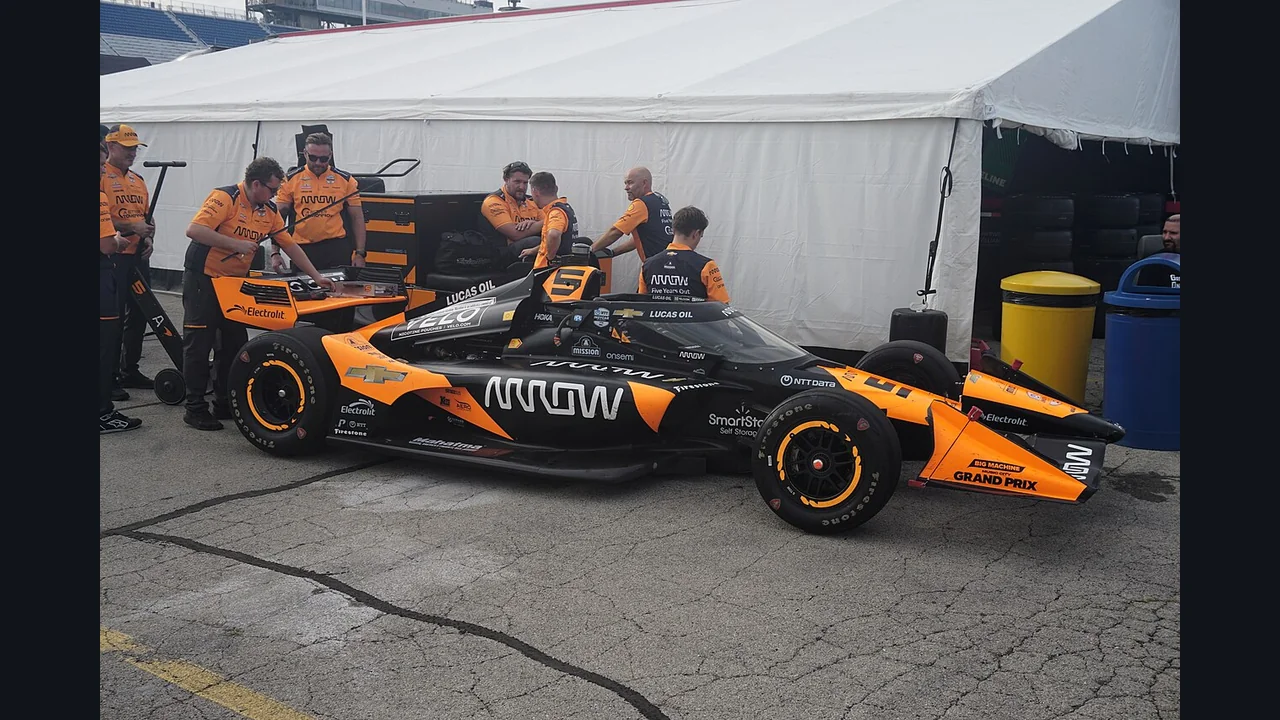
An in-house tool for development and preparation
ECR has selected Dynisma’s DMG-1 simulator, scheduled for delivery in Indianapolis in the first quarter of 2027. The November 3 announcement identifies the team as Dynisma’s first announced IndyCar customer. Driver-in-the-Loop simulation involves the driver alongside engineers and will support setup work, race preparation and vehicle-model development.
Two different milestones: 2027 and 2028
The simulator arrives ahead of the Dallara IR-28’s planned competitive introduction in 2028. ECR driver Alexander Rossi is already involved in developing that car. At Sebring on October 13 he completed 134 laps, following Alex Palou’s running the previous day. Circuit testing evaluates real loads; the new investment adds a repeatable working environment between track outings.
What sub-five-millisecond latency describes
The announcement specifies motion latency below 5 ms and primary motion bandwidth above 50 Hz for the DMG-1. These are supplier specifications, rather than measurements by APEX. APEX technical explanation: the delay between a command and the platform’s response affects the coherence of the cues reaching a driver. A low figure cannot independently establish that the tyre or suspension model accurately reproduces the racing car.
The value must be demonstrated through correlation
APEX analysis: the useful question is whether a change assessed in simulation produces the expected effect at the circuit. That is correlation. A repeatable tool helps isolate a variable and organise comparisons, but physical validation remains necessary. A fast oval, a street circuit and a permanent road course each require different references. For ECR, the purchase confirms investment in engineering infrastructure; any competitive benefit still has to emerge through preparation and results.