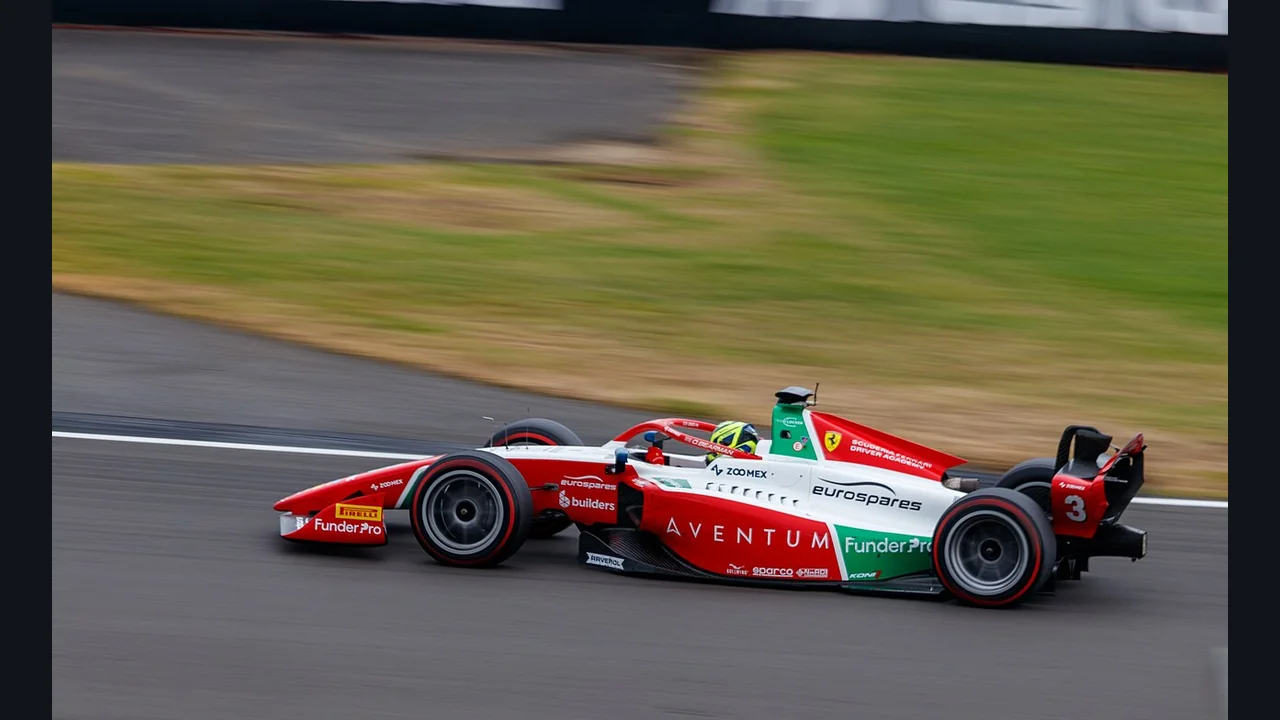
A profile shaped by two racing worlds
Colton Herta races for Hitech in Formula 2 during a rookie season in the series that overlaps with his Cadillac F1 test-driver role. In the exercise published by the championship, he builds an ideal driver by combining qualities from names in F1 and IndyCar. These are personal selections rather than the outcome of a statistical comparison between careers or racing cars.
His choices for each quality
Herta’s list combines Franchitti, Verstappen, Will Power, Hamilton, Hinchcliffe and Kirkwood, each associated with a skill. For bravery and overtaking, he selects himself. The table brings together his choices, including the qualities that extend beyond speed over a single lap.
| Quality | Selected driver |
|---|---|
| Intelligence | Dario Franchitti |
| Wet-weather driving | Max Verstappen |
| Qualifying | Will Power |
| Tyre management | Lewis Hamilton |
| Cornering and smoothness | James Hinchcliffe |
| Composure | Kyle Kirkwood |
| Bravery and overtaking | Colton Herta |
Experience before returning to Europe
Herta did not arrive in F2 without single-seater experience. His official biography records two European seasons before his return to the United States and progression through Indy Lights. During his first full IndyCar season in 2019, he became the series’ youngest race winner at 18. He finished third in 2020 and runner-up in 2024 before returning to Europe for the 2026 campaign.

Why tyres connect qualifying and racing
The relevance of tyre management also appears in fellow F2 driver Oliver Goethe’s account of his driving style. Goethe describes the delicate balance between getting the car to rotate and overheating its rear tyres. He stresses that precision matters even during a qualifying lap: asking too much too early can cost performance before the final corners. That provides technical context for two qualities listed separately by Herta, without assuming that the two drivers approach the task in the same way.
F2 tests those qualities in different ways
The championship’s standard format explains the stakes. Qualifying establishes the Feature Race grid, while the top ten positions are reversed for the Sprint. The Feature Race includes a compulsory stop to change all four tyres. Unless wet-weather tyres are used, both dry specifications must be run. A weekend therefore demands a fast qualifying attempt as well as decisions over a race distance. Starting position and the timing of a tyre change can alter how a driver uses the pace available in the car.
What the list says about a complete driver
Read as a portrait, Herta’s selection suggests a driver who can change emphasis according to the situation. The aggression that helps an overtake does not replace the patience required over a stint, and a very fast lap does not automatically solve an entire race. For an F2 audience, that is the interest of the exercise: the names illustrate different skills that must be combined in the same car during the same weekend. For example, starting in the midfield can create a need for more overtaking, whereas protecting a position at the front can place greater emphasis on sustaining pace.